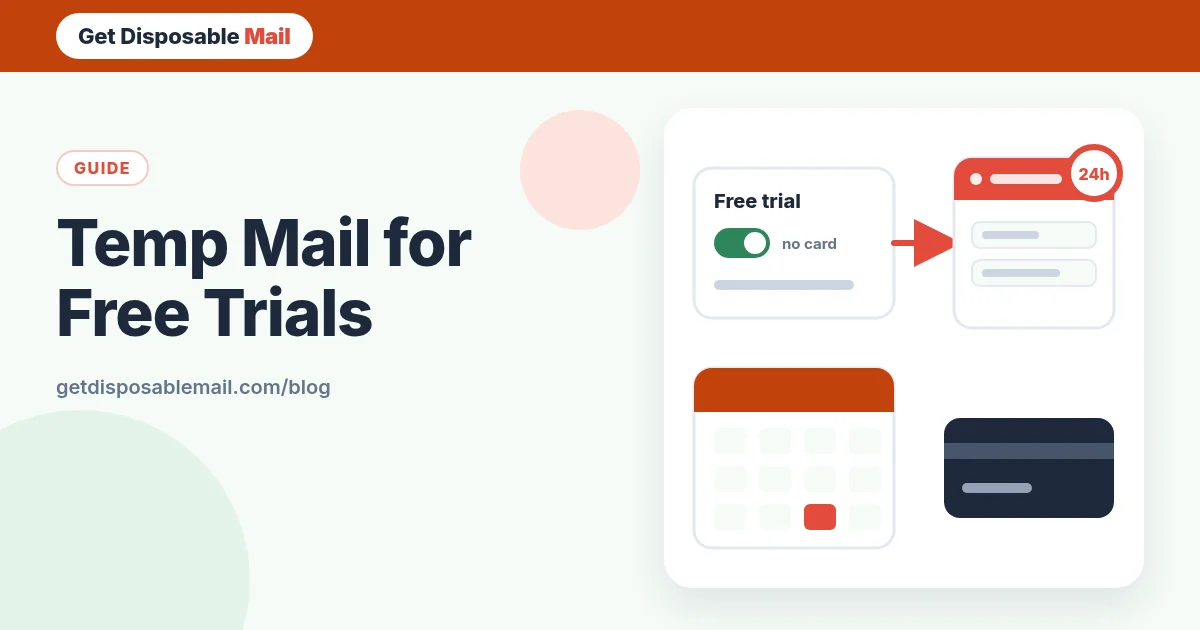
Free trials, gated e-books, template packs, webinar recordings, “enter your email to download” — they all want the same thing in exchange: your address, so they can keep emailing you. A temporary inbox is a natural fit for some of these. For others, it creates more trouble than the spam it saves.
Here’s a straightforward way to tell them apart, plus the one trial trick we’ll ask you not to use.
Where temp mail is a great fit
- Gated downloads — white papers, e-books, checklists, wallpapers, sample files. You need the download link once.
- Webinar and event recordings you just want to watch.
- Free tools with no card required that you’re only evaluating. If you decide to keep using it, switch the account to a permanent address while you still can.
- Newsletter previews — see a few issues before committing your real inbox.
- Coupon or price-alert sign-ups you’ll use once.
In all of these, the value arrives in the first email or two, and the rest is marketing you didn’t ask for. Open GetDisposableMail, paste the address, grab the link, and let the inbox expire after 24 hours.
Where it backfires
Trials that take your card
If a trial converts to a paid plan unless you cancel, the emails that matter — the trial-ending reminder, the first invoice, the cancellation confirmation — will go to an address that no longer exists. If something goes wrong, you’ll have no paper trail to show your bank. The US Federal Trade Commission’s consumer advice on cancelling services stresses checking renewal and cancellation terms and keeping written confirmation. Use your real address or an alias here.
Anything you might buy or keep
Purchases need receipts for returns, warranties and disputes. Software licences are often tied to the email you bought with. Accounts you keep need password resets. For all of these, a forwarding alias gives you privacy without the lock-out risk — our disposable vs alias comparison explains how.
Services that block disposable domains
Many SaaS companies block temporary addresses at sign-up precisely because of trial abuse. If the confirmation never arrives, that’s probably why. Respect it and use another address type; see why some sites block disposable email.
The trick we won’t help with: repeat trials
Creating a fresh address every month to restart a “one per customer” trial, or to claim new-customer discounts and referral bonuses again and again, breaks almost every service’s terms. Companies detect it with more than the email — card numbers, devices and payment fingerprints — and it can lead to closed accounts or worse. It’s also against our own terms of service.
If a trial wasn’t long enough to decide, ask. Many companies will extend it for a genuine evaluation, especially for business software.
There’s a practical cost too. Every throwaway account you abandon takes your settings, uploads and history with it. If you end up liking the product, you start from scratch — and if the company links the accounts, you may lose the paid one as well. A single honest trial on an address you can keep is usually the faster route to a decision.
A decision guide
- Will I need any email from them after today? No → temp mail. Yes → keep going.
- Does it take payment details? Yes → real address or alias, and set a calendar reminder.
- Might I keep using it? Yes → alias, so you can recover the account later.
- Is it banking, work, health or government? Always your real, secured address.
Free-trial hygiene, whatever address you use
- Read the terms before you start: trial length, price after, how to cancel.
- Put the end date in your calendar, a couple of days early.
- Untick pre-checked boxes for extra products or partner offers.
- Cancel through the official account page and save the confirmation.
- Check your card statement after the trial ends. If you’re charged after cancelling, contact the company first, then your card issuer.
Getting the download without the spam
For the cases where temp mail fits, the routine takes under a minute:
- Open a temporary inbox and copy the address.
- Paste it into the download or sign-up form and untick marketing boxes anyway.
- Keep the tab open; the email appears live. Download the file right away — links often expire.
- Be careful with attachments you didn’t expect. Our inbox blocks many dangerous file types, but stay cautious.
- Need it on your phone? Use Save to get a private link or QR code for the same inbox.
The bottom line
Temporary email is ideal for the one-and-done parts of the internet: downloads, previews and no-card evaluations. Once money, receipts or an account you might keep are involved, switch to an address you’ll still control next month. And skip the repeat-trial games — they’re not worth losing access over. For more on choosing the right address, see the email privacy checklist.
Three quick scenarios
A design template pack
A site offers a free pack of templates in exchange for your email. You want the files, not a weekly newsletter. This is the textbook case for a temporary inbox: download the files as soon as the email arrives and let the address expire.
A project-management tool, 14 days, no card
You’re comparing three tools for a small team. Starting each trial with a temporary address keeps the onboarding drip campaigns out of your inbox while you evaluate. The moment you pick a winner, change the account email to a permanent work address in its settings — before the temporary inbox expires — so invoices and password resets reach you.
A streaming service, 30 days, card required
This one belongs on an address you keep. The trial converts to a paid subscription automatically, and the renewal notice and cancellation confirmation are your evidence if a charge goes wrong. Use an alias if you want privacy, and put the cancel-by date in your calendar.
Frequently asked questions
Can I use temp mail for a free trial?
For trials that don’t ask for a card and that you’re only evaluating, yes — it keeps the follow-up marketing out of your inbox. For trials that take payment details, use an address you’ll keep, because you’ll need the receipts, renewal reminders and cancellation confirmation.
Is it OK to use a new temp email to get another free trial?
No. Most services allow one trial per person, and creating new accounts to restart a trial usually breaks their terms and can be treated as fraud. We don’t support using GetDisposableMail for that. If you need more time, ask the company — many will extend a trial.
What happens if I forget to cancel a trial I signed up for with temp mail?
The service may keep charging your card, and the reminder and cancellation emails will go to an address that no longer exists. That’s exactly why card-based trials belong on a permanent address or alias.
Why didn’t my trial confirmation arrive?
Many SaaS products block disposable domains to prevent trial abuse. If the email never arrives, the site probably refuses temporary addresses — use an alias or your real address instead.
How do I avoid being charged after a free trial?
Read the terms before you start, note the end date in your calendar, untick pre-checked boxes, cancel a day or two early and keep the confirmation. If you’re charged anyway, contact the company and then your card issuer.